Explore specialized lengths and high-cube refrigeration platforms certified for maritime, rail landbridge, and harsh industrial environments.
Understanding the geotechnical, structural, and regulatory trade-offs governed by ISO 668 Series 1 standards across global supply chains.
In high-volume international trade, cargo container length represents far more than an external physical dimension; it is the fundamental volumetric index governing vessel cell guides, reach-stacker axle loads, and intermodal railway clearance envelopes worldwide. Under the strict parameters of ISO 668 Series 1 freight containers, lengths are standardly calibrated to nominal 10-foot (2,991 mm), 20-foot (6,058 mm), 30-foot (9,125 mm), 40-foot (12,192 mm), and 45-foot (13,716 mm) profiles, with regional North American domestic corridors accommodating extended 53-foot platforms.
The commercial selection between a 20-foot Twenty-Foot Equivalent Unit (TEU) and a 40-foot Forty-Foot Equivalent Unit (FEU) High-Cube represents an ongoing operational calculation between volumetric limit (cube-out) versus permissible gross mass (weigh-out). While heavy bulk mineral shipments, chemical ISO tanks, and concentrates inevitably require 20ft structures to prevent road chassis axle-weight violations, consumer electronics, e-commerce fast-moving goods, and palletized agricultural food products demand the 76.4 m³ interior displacement of a 40ft High-Cube container.
As maritime carriers navigate post-panamax slot optimization and decarbonization mandates, the structural efficiency ratio—tare weight relative to safe working payload—has emerged as a principal KPI. Factory-level dimensional tolerance management within ±2 mm along the longitudinal corner casting axis ensures flawless automated twistlock engagement on high-speed gantry cranes across global deep-sea transshipment hubs.
Verified engineering metrics covering external length, internal operational clearance, tare mass, maximum payload, and thermal performance classifications.
| ISO Designation / Type | External Length (mm / ft) | Internal Clear Length | Door Aperture (W × H) | Tare Weight (±2%) | Max Gross Payload | Displacement / Pallets |
|---|---|---|---|---|---|---|
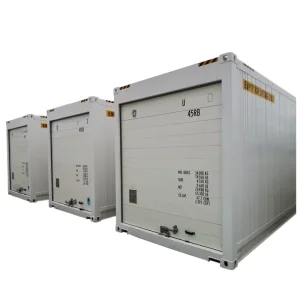
| 10ft Standard Dry / Offshore | 2,991 mm (9' 9.75") | 2,831 mm (9' 3.4") | 2,280 × 2,134 mm | 1,300 kg (2,866 lbs) | 8,700 kg (19,180 lbs) | 15.8 m³ / 4 Euro-pallets |
| 20ft Standard Dry (1CC) | 6,058 mm (19' 10.5") | 5,898 mm (19' 4.2") | 2,340 × 2,280 mm | 2,230 kg (4,916 lbs) | 28,250 kg (62,280 lbs) | 33.2 m³ / 11 Euro-pallets |
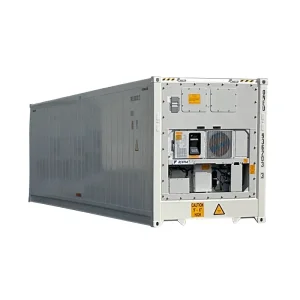
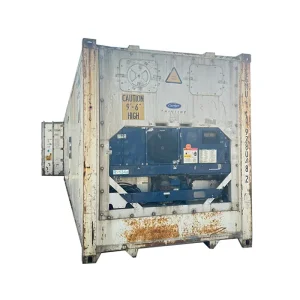
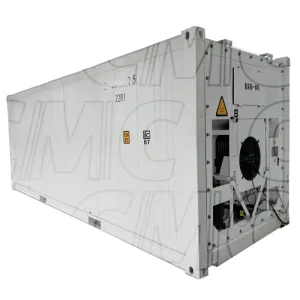
| 20ft High-Cube Reefer (1CCD) | 6,058 mm (19' 10.5") | 5,444 mm (17' 10.3") | 2,290 × 2,535 mm | 3,080 kg (6,790 lbs) | 27,400 kg (60,406 lbs) | 28.4 m³ / 9 Euro-pallets |
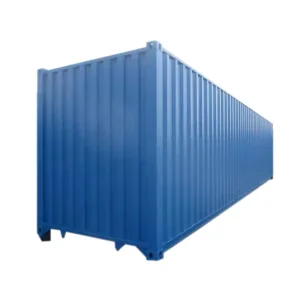
| 40ft Standard Dry (1AA) | 12,192 mm (40' 0.0") | 12,032 mm (39' 5.7") | 2,340 × 2,280 mm | 3,740 kg (8,245 lbs) | 26,740 kg (58,951 lbs) | 67.7 m³ / 24 Euro-pallets |
| 40ft High-Cube Dry (1AAA) | 12,192 mm (40' 0.0") | 12,032 mm (39' 5.7") | 2,340 × 2,585 mm | 3,900 kg (8,598 lbs) | 28,600 kg (63,052 lbs) | 76.4 m³ / 25 Euro-pallets |
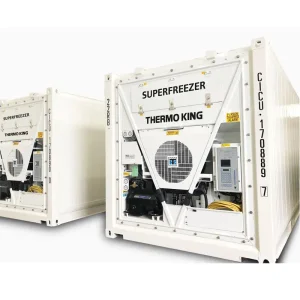
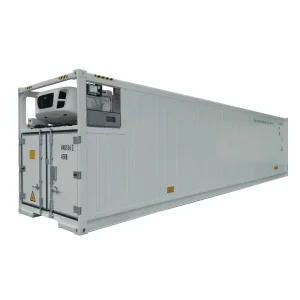
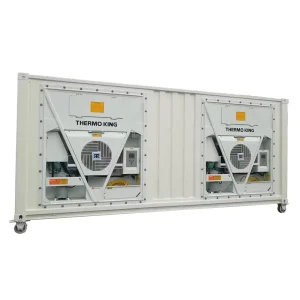
| 40ft High-Cube Reefer (Thermo King/Daikin) | 12,192 mm (40' 0.0") | 11,583 mm (38' 0.0") | 2,290 × 2,535 mm | 4,480 kg (9,876 lbs) | 29,520 kg (65,080 lbs) | 67.5 m³ / 23 Euro-pallets |
| 45ft High-Cube Pallet-Wide | 13,716 mm (45' 0.0") | 13,556 mm (44' 5.7") | 2,410 × 2,585 mm | 4,820 kg (10,626 lbs) | 29,180 kg (64,330 lbs) | 89.2 m³ / 33 Euro-pallets |
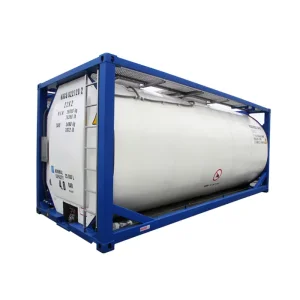
| 20ft Chemical ISO Tank (T11/T14) | 6,058 mm (19' 10.5") | Cylindrical Vessel | Manhole Ø 500 mm | 3,650 kg (8,046 lbs) | 32,350 kg (71,320 lbs) | 26,000 Liters Nominal |
Deploying robotic tandem-wire sub-arc welding, laser CNC blanking, and direct port connectivity to deliver uncompromised quality at peak scale.
All structural side panels, corrugation profiles, and corner posts are fabricated exclusively from certified metallurgical SPA-H corrosion-resistant steel. This alloy naturally generates an impervious passivating oxide layer upon continuous exposure to marine salt-fog, guaranteeing an operational design lifespan exceeding 15 to 20 years in transoceanic freight.
Utilizing 6-axis KUKA continuous robotic seam welding cells ensures continuous penetration across top/bottom side rails and corner castings. Robotic welding eliminates cold-lap defects and pinholes, producing leak-proof assemblies that comfortably exceed Bureau Veritas (BV) and American Bureau of Shipping (ABS) cyclic pressure requirements.
With centralized fabrication yards located within 100 kilometers of the mega-deepwater terminals of Tianjin and Shanghai/Suzhou, export units transition directly from assembly lines into container yards without costly drayage. Port integration facilitates immediate "One-Way Free-Use" repositioning programs to minimize empty sea freight costs for international buyers.
From extreme arctic temperature gradients across the Eurasian rail landbridges to dynamic wave-impact forces in North Sea offshore rigs.
40ft High-Cube and 45ft specialized containers deployed on the 10,000 km Belt & Road railway routes must endure extreme thermal swings from -45°C in Kazakhstan to +40°C in coastal terminals. Fitted with diesel-electric hybrid clip-on generator sets (gensets) and dual-circuit insulation, these reefers sustain continuous pharmaceutical and sensitive high-tech electronics cold chains without grid support.
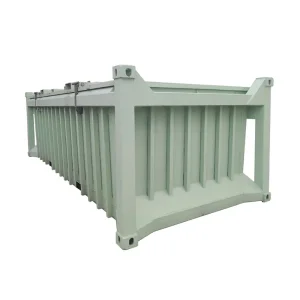
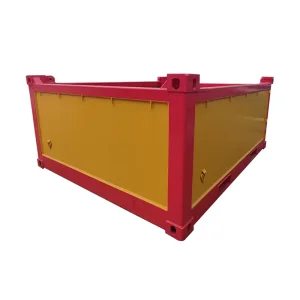
Standard 40ft containers fail when loaded with heavy bauxite, copper cathode, or lithium spodumene ore due to extreme floor pressure. Heavy-duty 20ft reinforced half-height open-top containers feature high-yield bottom rail beams and removable tarpaulins, enabling rapid overhead tipper discharge at mineral bulk processing terminals while avoiding road overloading.
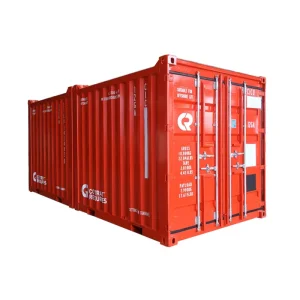
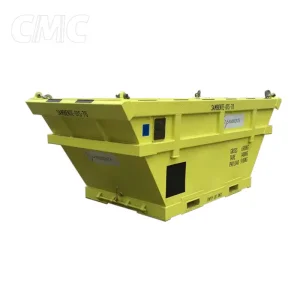
In North Sea and Gulf of Guinea offshore extraction platforms, wave-induced dynamic acceleration renders standard ISO containers unsafe for dynamic sea crane hoisting. Specialized offshore dry boxes, tool baskets, and silt skips are engineered to DNV-GL 2.7-1 / EN 12079 standards, featuring four-point certified sling sets, Charpy V-notch tested steel at -20°C, and explosion-proof certified electrical loops.
Pioneering the transformation from passive steel freight boxes into active, telemetry-connected intelligent logistics assets.
Next-generation 40ft HC reefers incorporate low-power 5G/NB-IoT satellite transceivers that monitor internal air temperature, relative humidity, oxygen/carbon dioxide ratios (controlled atmosphere), and compressor electrical draw. Cloud telemetry platforms trigger preventive alerts before thermal excursions risk high-value biopharmaceutical cargo.
Addressing cold-chain food security across off-grid developing regions, factories integrate low-profile roof-mounted crystalline silicon solar arrays coupled with DC inverter units. These hybrid containers harvest clean solar energy by day, automatically switching to 220V grid or auxiliary diesel backup at night, slashing diesel consumption by up to 65%.
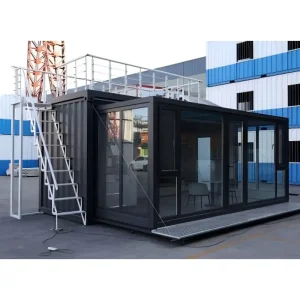
Factory conversion of standardized 20ft and 40ft container chassis into scalable, foldable, expandable modular structures is revolutionizing temporary worker base camps, emergency field clinics, and luxury hospitality villas. Utilizing container structural exoskeletons lowers concrete foundation needs while providing verified seismic and cyclone resistance.
Strategic guidance for supply chain directors, fleet managers, and engineering EPC contractors evaluating direct Chinese factory OEM procurement.
Tier-1 international buyers must mandate five critical non-negotiable verification gates before vessel manifest issuance:
Procurement decisions must balance initial FOB manufacturing outlay against twenty-year asset lifecycle economics:
Detailed technical answers addressing custom length tolerances, reefer machinery selection, structural certifications, and international drayage compliance.
While 40ft and 45ft containers offer significantly greater volume, their gross payload is often limited by regional road bridge formulas. In the United States (Federal Bridge Gross Weight Formula), a standard tandem-axle chassis typically restricts cargo inside a 40ft unit to around 44,000 lbs (19,958 kg). Dense commodities that exceed this weight threshold before filling the volume must be loaded into 20ft units mounted on specialized tri-axle slider chassis to remain compliant.
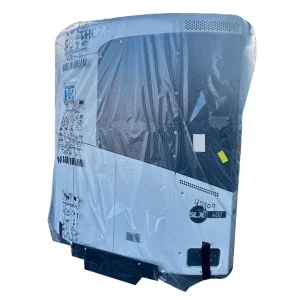
Due to the front-wall bulkhead housing the refrigeration unit (Thermo King, Carrier, or Daikin) and high-density polyurethane foam sandwich insulation panels (75 mm to 100 mm thickness), an active reefer container exhibits a shorter internal cargo footprint. A standard 40ft HC dry box features an internal length of 12,032 mm, whereas a 40ft HC reefer has an internal length of approximately 11,583 mm—a reduction of roughly 449 mm.
Yes. Every container intended for commercial intermodal shipping—regardless of custom length—must undergo rigorous type testing per the International Convention for Safe Containers (CSC). This includes stacking tests (supporting up to 216,000 kg for a 9-high laden stack), transverse racking, end-wall strength, and floor deflection tests witnessed by classification society surveyors (Bureau Veritas, DNV, ABS, or CCS) before CSC safety plate issuance.
Standard ISO containers are engineered primarily for static vessel cell stacks and vertical dockside crane lifting. Offshore containers built to DNV 2.7-1 / EN 12079 are structurally fortified to withstand dynamic offshore waves and rough vessel-to-rig transfers. They incorporate primary structural steel with Charpy impact testing at -20°C, heavy padeyes welded directly into the frame, integrated 4-part wire rope lifting slings, and no corner castings on the top perimeter to avoid snagging crane cables.
The decision typically hinges on local maintenance networks and cargo specifics. Thermo King (such as the Magnum Plus) is renowned for ultra-low temperature capabilities reaching -40°C and fast pull-down speeds. Carrier Transicold (ThinLINE / PrimeLINE) holds widespread global parts ubiquity and digital diagnostics. Daikin excels in fine-tuned temperature stability (±0.25°C) and advanced active controlled atmosphere (CA) systems preferred for premium fresh produce.
Standard ISO dry boxes in 20ft and 40ft dimensions are routinely supplied from existing coastal terminal stock or completed within 15–20 days. Custom engineered configurations—including side-opening doors, integrated roll-up shutters, explosion-proof offshore modifications, or modular housing framing—typically require 25 to 40 days, encompassing technical drawing sign-off, laser cutting jigs, prototype welding, blast priming, and classification surveyor witness inspections.
Explore specialized certified platforms engineered for offshore extraction, blast refrigeration, hazardous bulk transport, and scalable modular infrastructure.