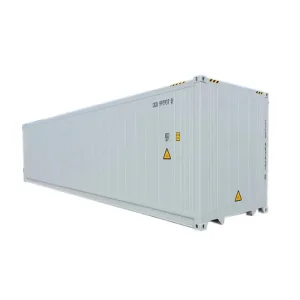
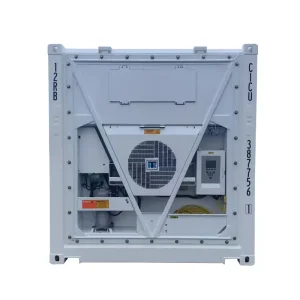
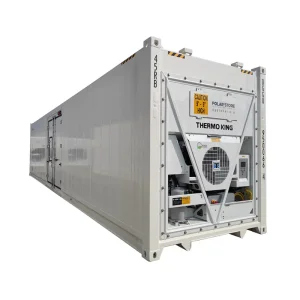
Directly sourced from premier manufacturing facilities in Tianjin and Suzhou. Validated for high throughput, seamless seal integrity, and classification society compliance.
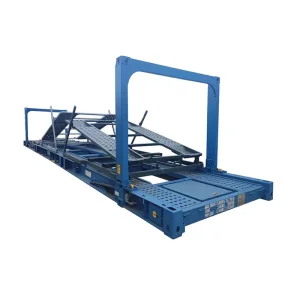
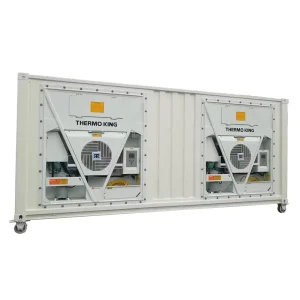
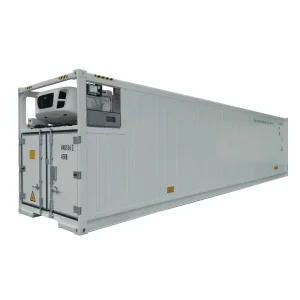
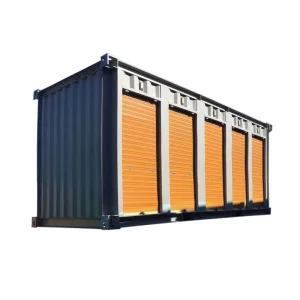
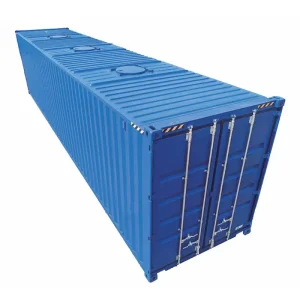
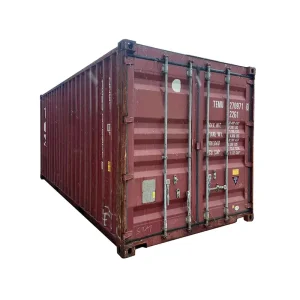
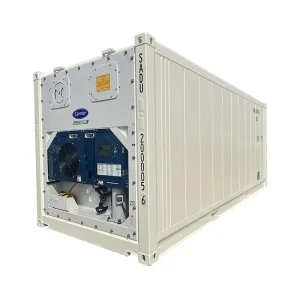
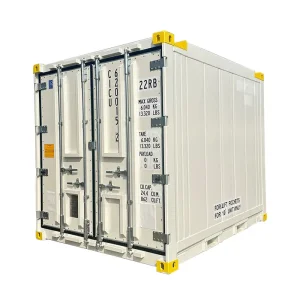
Bridging the gap between heavy intermodal maritime cold chains and rapid urban last-mile replenishment through optimized aperture mechanical engineering.
In high-density industrial logistics, conventional double-swing hinged container doors require a minimum radial swing perimeter of 1,200 mm to 1,500 mm behind the transport chassis or loading dock. In compressed urban multi-temperature distribution hubs, congested maritime apron terminals, and automated narrow-aisle cross-docking facilities, this angular clearance requirement translates into severe spatial inefficiency, loading delay, and elevated mechanical hazard risks. When traditional cargo containers back up to elevated dock seals, swing doors must be unlatched and swung 270 degrees against the exterior container sidewall prior to reversing into the rubber compression cushion. This premature exposure exposes pre-cooled loads to ambient thermal shock and humid air ingress long before actual unloading commences.
The roll-up door refrigerated container—pioneered and manufactured at industrial scale in China by precision fabricators like Tianjin Cimic Imp&Exp Co., Ltd. (founded 1983)—fundamentally eliminates spatial clearance penalties. Operating within a vertical track system integrated flush into the rear end frame (or configured across longitudinal side apertures), insulated architectural sectional roll-up doors allow vehicle backing directly flush into warehouse dock seals prior to door actuation. The aperture opens vertically inside the container envelope, completely preventing thermal transfer until air seal stabilization is achieved.
Historically, the primary engineering barrier preventing broad deployment of roll-up curtains in active reefer equipment was thermal bridging and joint micro-leakage. Standard swing doors utilize thick 75 mm to 100 mm single-slab polyurethane cores enclosed in stainless steel or aluminum lining with dual continuous EPDM perimeter compression gaskets. Roll-up curtain systems inherently feature segmented horizontal slats, introducing multiple articulating hinge lines that can succumb to air infiltration under deep-freeze negative pressure differentials (-25°C to -35°C interior vs. +40°C exterior).
Leading Chinese refrigerated container manufacturing plants have mastered advanced thermodynamic mitigation via composite tongue-and-groove joint profiles, co-extruded elastomeric santoprene thermal seals, and high-density, closed-cell cyclopentane-blown polyurethane foam insulation injected at high pressures into each slat. Specialized extruded aluminum outer skins with inner thermal break PVC sleeves prevent thermal conductivity from the exterior structural skin to the interior food-grade lining, keeping overall thermal transmission factors strictly below the rigorous ATP Class FRC requirement of $K \le 0.40\,\text{W/m}^2\text{K}$.
From quick-commerce grocery fulfillment to critical vaccine distribution, specialized roll-up door reefers unlock mission-critical operational advantages.
Urban distribution centers utilize stationary or modular 20ft and 40ft roll-up reefer units as decentralized temperature-zoned micro-fulfillment pods. Operators experience rapid single-operator roll-up actuation in seconds, reducing dock queue congestion and minimizing defrost load spikes during repetitive order picking.
Transporting temperature-critical biopharmaceuticals, blood plasmas, and APIs requires uninterrupted cold-chain documentation (+2°C to +8°C and -20°C deep freeze). Roll-up reefers equipped with high-speed automated vertical doors interface perfectly with hermetic pharmaceutical clean-dock vestibules under GDP guidelines.
Customized 40ft High-Cube and 45ft containers deployed across Eurasian railway and domestic trunk lines face high vibrational stress. Specially reinforced roller carriage tracks and bottom locking cams preserve positive gasket sealing through intense acceleration and thermal shifts from -40°C to +50°C.
Rigorous trade-off evaluation comparing classic marine swing door mechanisms, modern insulated sectional roll-up systems, and lateral side-access designs.
| Performance Metric | Standard Rear Swing Door | High-Cube Roll-Up Reefer Door | Full Side-Opening Reefer Door |
|---|---|---|---|
| Dock Clearance Required | 1,200 mm – 1,500 mm radial sweep | 0 mm (True zero dock clearance) | 2,500 mm lateral zone clearance |
| Cycle Turnaround Time | 60 – 120 seconds (Manual lashing) | 8 – 15 seconds (Motorized/Counterbalanced) | 90 – 180 seconds (Multi-cam levers) |
| Thermal Bridge Factor (K-Value) | 0.32 – 0.36 W/m²K (Superior insulation) | 0.36 – 0.39 W/m²K (ATP FRC Compliant) | 0.38 – 0.42 W/m²K (Moderate bridge risk) |
| Dock Air Seal Compatibility | Poor (Doors open prior to seal mating) | Optimal (Door opens inside sealed dock) | Specialized external curtain required |
| Structural Corner Post Torsion | Standard ISO end-frame compliance | Reinforced dual-column box channels | Substantial bottom sill reinforcement |
| Ideal Cargo Application | Bulk long-haul maritime shipping | FMCG, Urban Hubs, Express Picking | Oversized breakbulk, machinery, aircraft parts |
How Chinese container engineering leads the world toward carbon-neutral operation, IoT monitoring, and aerogel-composite insulation.
Integrating organic PCM eutectic slabs within ceiling lining and roll-up slat cores. Absorbing latent thermal spikes during roll-up door operational cycles reduces active compressor runtime by up to 28% in hot climates.
Real-time edge microcontrollers measuring door aperture cycling frequency, relative inside humidity, and ambient solar loads. Predictive algorithms adjust modulation valves on Carrier, Thermo King, and Daikin compressors in anticipation of thermal ingress.
Replacing conventional exterior aluminum profiles with resin-transfer molded (RTM) carbon and basalt fiber composite skins, achieving a 40% reduction in moving curtain weight while entirely eliminating thermal conduction bridges.
Embedded ultrasonic transducer arrays scan roll-up perimeter seals upon closure, immediately alerting fleet control towers to gasket micro-deformations, frost accumulations, or particulate obstructions before thermal leakage occurs.
Every custom container is built to pass international maritime, offshore, rail, and hygiene standards.
Certified under Bureau Veritas (BV), Lloyd's Register (LR), China Classification Society (CCS), and ABS rules. Structural builds comply with ISO 1496-2 (thermal containers) and ISO 668 external dimension guidelines, ensuring global interchangeability and safety.
For marine drilling rigs and supply vessels, CIMIC engineers custom units built to DNV 2.7-1 / EN 12079 dynamic offshore lifting mandates. Featuring reinforced padeyes, specialized material Charpy impact testing at -20°C, and marine offshore slings.
With modern manufacturing facilities strategically positioned in Tianjin and Suzhou—approximately 100 kilometers from primary international shipping ports—finished units proceed straight from assembly to deep-water vessel bays, reducing inland drayage expenses and delivery lead times.
Direct technical clarifications on custom dimensions, refrigeration machinery, thermal performance, and global supply logistics.
Our roll-up curtains feature patented dual-durometer EPDM thermal breaks integrated into every articulating joint, combined with low-wattage resistance heater wire channels integrated into the vertical guide tracks. This eliminates condensation buildup and prevents curtain freezing during deep-subzero operations.
We engineer front-end bulkhead frames fully compatible with all premier global refrigeration original equipment manufacturers, including Thermo King (Magnum Plus), Carrier Transicold (ThinLINE / PrimeLINE), and Daikin (LXE series), ensuring worldwide spare parts availability.
Standard production umfasst 10ft, 20ft standard, 20ft High Cube, 40ft standard, and 40ft High Cube (9'6" height). Additionally, bespoke custom lengths, wide-body pallet containers, and 45ft rail-optimized units are produced via our dedicated ODM engineering line.
Modifying the rear end frame to accept roller guides requires heavy-gauge high-tensile Corten-A steel box sections for the rear corner posts and top header beam. Every structural design undergoes finite element analysis (FEA) and physical ISO 1496 transverse racking and 9-high corner post stacking tests witnessed by BV or CCS surveyors.
Yes. Every electric motorized shutter system is engineered with an industrial-grade manual spring-counterbalanced chain override system and a mechanical clutch release mechanism, ensuring immediate manual opening or closing during dock power outages.
Standard configured reefer and dry models can dispatch within 15–25 business days from Tianjin and Suzhou factory depots. Custom ODM and OEM configurations involving unique door placements, dual-temperature bulkheads, or offshore certifications are typically manufactured within 30–45 days.
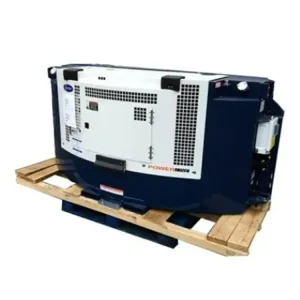
Explore our full spectrum of intermodal shipping containers, specialized chemical tanks, diesel generator sets, and prefabricated structures manufactured in China.