Direct manufacturer deployment from Tianjin and Suzhou logistics hubs. Fully inspected, seaworthy units certified for international maritime intermodal transport.
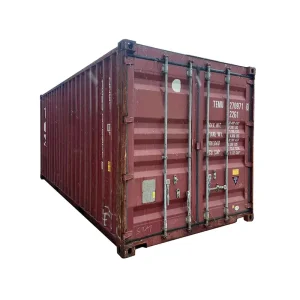
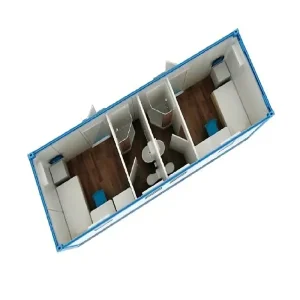
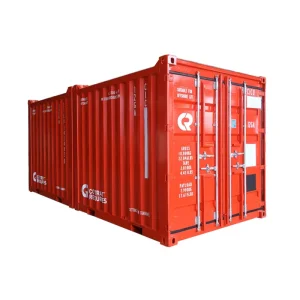
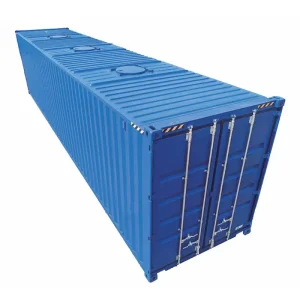
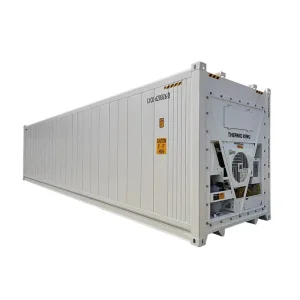
A comprehensive examination of what sets high-performance refrigerated maritime containers apart: metallurgy, floor profile aerodynamics, and seamless thermal envelope containment.
The interior floor is precision-machined with 6061-T6 structural alloy T-bars, engineered to deliver continuous bottom-air discharge up to 5,500 m³/h. Deep airflow channels prevent cold-pocket dead zones while offering dynamic forklift wheel load resistance up to 7,260 kg (ISO 1496-1 standard testing).
Interior walls and ceiling bulkheads are clad in AISI 304/DIN 1.4301 deep-drawn mirror or satin stainless steel sheets. This guarantees zero toxicity, resistance to high-salinity fish blood, washdown chemical resilience, and prevents bacterial colonisation under continuous condensing cycles.
High-pressure, multi-nozzle injected polyurethane foam with cyclopentane eco-blowing agents fills the vacuum space between Corten steel outer walls and SUS 304 inner cladding. Achieves exceptional thermal conductivity (K-factor ≤ 0.33 W/m²·K), preserving payload integrity even through +50°C tropical ambient peaks.
Inside reefer containers, maintaining biological latency in perishables and thermal stability in sensitive biopharmaceuticals demands far more than basic refrigeration. Modern cold chains operate under strict microbiological and physiological thresholds.
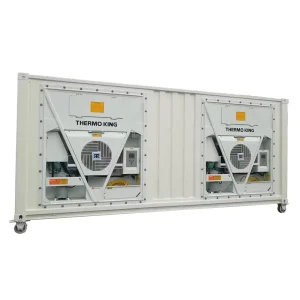
Our integrated container shells house world-class micro-channel evaporators, electronic expansion valves (EEV), and digital scroll compressors engineered by Carrier (ThinLINE/PrimeLINE), Thermo King (Magnum Plus), and Daikin (Zestia). These units modulate output with variable frequency inverters, cutting power draw up to 35% compared to legacy on-off cycle units.
Unlike standard static cold storage rooms that circulate air from the top down, an ISO reefer utilizes a bottom-air delivery system. Cold supply air enters the floor channels beneath cargo pallets via centrifugal evaporator fans, rising vertically through ventilation openings.
Critical Operational Rule: Cargo must never be stowed beyond the red load ceiling line (baffling strip), ensuring the return-air loop remains unobstructed. Breaching this limit can cause immediate heat buildup in top cargo tiers.
Why Tier-1 international shipping lines, refrigerated container leasing syndicates, and sovereign logistics operators center their reefer procurement within Chinese maritime clusters.
Our manufacturing headquarters and assembly grounds sit roughly 100 kilometers from Tianjin Xingang and Shanghai-Taicang deepwater container berths. This short transit route slashes domestic pre-carriage costs, speeds up factory-to-vessel turnarounds, and provides direct access to high-frequency liner schedules for North America, Europe, Africa, and Southeast Asia.
State-of-the-art multi-axis CNC fiber laser cutting systems and robotic pulse MIG/TIG welding arrays fabricate Corten-A weathering steel outer skins, corner castings, and structural frames with sub-millimeter tolerances. This precision fit-up ensures zero frame deflection during 9-high fully laden maritime stacking trials.
China is home to over 90% of the world's intermodal container manufacturing ecosystem. From primary bauxite smelting for specialized floor extrusions to in-country assembly plants for Carrier, Daikin, and Thermo King units, every component is sourced within regional industrial corridors—eliminating supply bottlenecks.
| Performance Dimension | CIMIC China Manufacturing Hub | European / North American Regional Builders | Global Industry Standard Benchmark |
|---|---|---|---|
| Frame Steel Spec | SPA-H High-Tensile Corten Weathering Steel | Standard S355 / Cor-Ten Grade equivalent | ISO 1496-1 structural minimums |
| Pre-Shipment PTI Testing | Automated 12-Hour Rigorous Digital PTI | Manual 4-8 Hour Pre-Trip Inspection | Standard IICL Reefer Guidelines |
| Exterior Coating Cycle | Zinc-Rich Primer + Epoxy Mid + PU Finish (≥200 μm) | 120 - 160 μm Conventional Marine Paint | ISO 12944 C5-M Very High Marine Corrosivity |
| Batch Lead Time (50-200 TEU) | 18 – 25 Calendar Days | 60 – 90 Calendar Days | 45 – 60 Calendar Days Average |
| Compliance Certification | BV, ISO, DNV, ABS, CCS Certified | Standard CE / Domestic Certs | Single Classification Society Mark |
Every reefer container leaving our production bays is backed by verifiable documentation recognized across all primary commercial ports and borders:
A shipping container is only as reliable as its field support network. We pair factory production with a global warranty and technical service framework, helping buyers keep maintenance costs predictable across major international trade lanes.
Through strategic partnerships with authorized Carrier Transicold, Thermo King, and Daikin depot networks in over 120 countries, warranty claims, spare parts distribution (controllers, thermistors, evaporator fan motors, compressor oil filters), and field emergency callouts can be handled locally—minimizing dwell time for loaded units.
Additionally, we maintain substantial inventory pools of certified used and one-trip reefers across major Chinese coastal hubs (Tianjin, Qingdao, Shanghai, Ningbo, Shenzhen). This allows rapid equipment positioning when global produce harvest seasons surge unexpectedly.
From cryogenic blast freezers on remote fishing grounds to dual-temperature modular units for emergency relief, container cold chains are expanding far beyond conventional shipping routes.
Geared for premium yellowfin/bluefin tuna, deep-sea cod, and high-value vaccine concentrates. Cascaded dual-stage refrigeration loops and vacuum-insulated secondary panels preserve biological cellular integrity, preventing muscle oxidation and retaining sashimi-grade texture without structural dehydration.
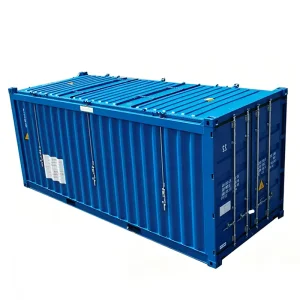
Agribusinesses use side-door opening reefers and roll-up shutter units directly adjacent to harvest fields. This bypasses expensive brick-and-mortar warehouse construction, providing instant, depreciable capital cold storage with zero structural foundation permitting hurdles.
Global shipping lines are rapidly retiring legacy R-134a systems in favor of next-generation low Global Warming Potential alternatives, including R-513A, R-1234yf hydrofluoroolefins, and natural CO2 (R-744) refrigerants, aligning fleets with stringent European F-Gas regulatory deadlines.
Complete project-ready equipment builds. Each unit passes comprehensive factory acceptance, vacuum holding, and digital PTI functional tests prior to export dispatch.
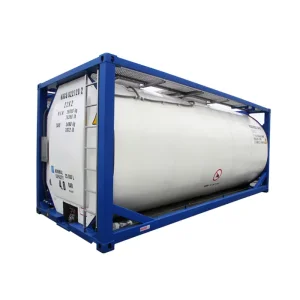
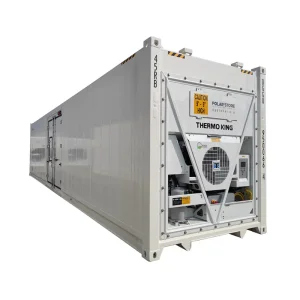
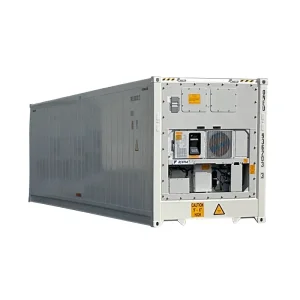
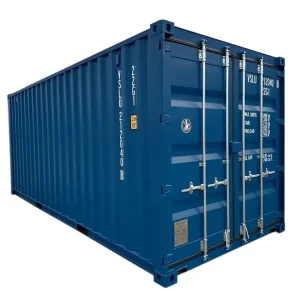
Essential guidance from our engineering desk covering thermal performance, power configurations, and operational maintenance.
Standard commercial walk-in cold rooms rely on top-down blowers that rely on convective sinking air. In contrast, inside an ISO reefer container, high-static pressure fans push conditioned air down a front vertical duct and force it horizontally across the floor through extruded aluminum T-bars. The air then rises through the cargo pallets and returns along the ceiling. This bottom-up airflow ensures every pallet core is reached, minimizing temperature stratification throughout dense shipments.
Standard international reefer machinery (Carrier, Thermo King, Daikin, Starcool) operates on 3-phase 380V/460V AC at 50/60 Hz, drawing around 10-15 kW during active pulldown and tapering to 3-6 kW at steady state. For operations on 3-phase 200V-220V grids, an auto-transformer (dual-voltage step-up transformer) is fitted. For road transport, standard clip-on or underslung diesel gensets deliver dedicated continuous 460V 3-phase power.
A PTI is an automated diagnostic cycle executed by the container's micro-controller. Over 2 to 4 hours, it methodically runs the equipment through electrical insulation resistance checks, compressor step-loading, electronic expansion valve travel, probe calibrations, defrost heater resistance, and temperature pulldown rates. Buying certified new or used reefers with stamped, validated PTI logs ensures the machine is mechanically sound and ready for high-value cargo before leaving our Tianjin or Suzhou yards.
Yes. We regularly execute OEM and ODM customizations, including insulated internal partition bulkheads (fixed or track-sliding) paired with secondary evaporator circuits for simultaneous frozen (-18°C) and chilled (+4°C) zones. We also integrate internal safety release panic handles, interior strip curtains to cut thermal loss during door openings, heavy-duty stainless steel shelving, and recessed LED floodlights.
