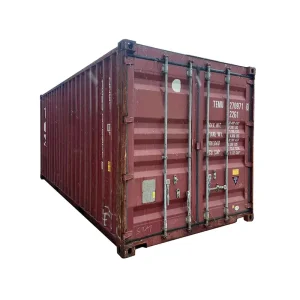
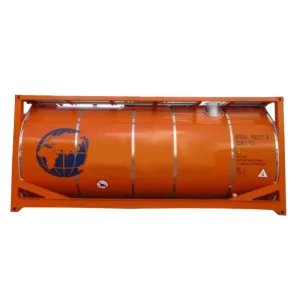
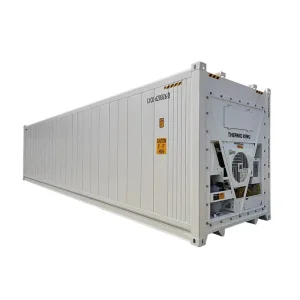
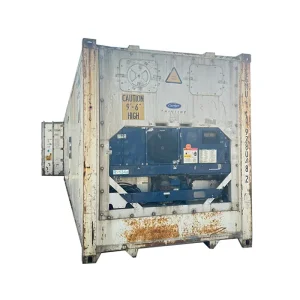
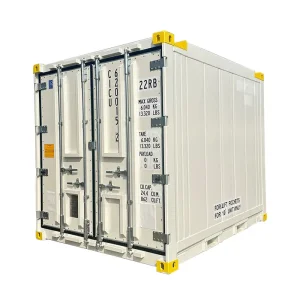
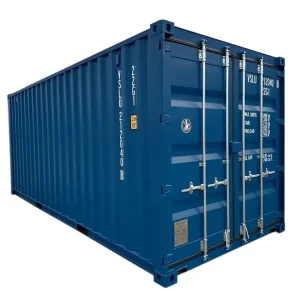
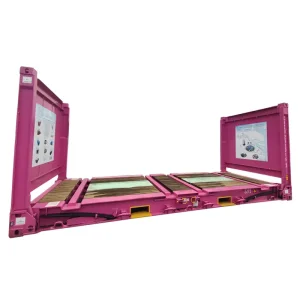
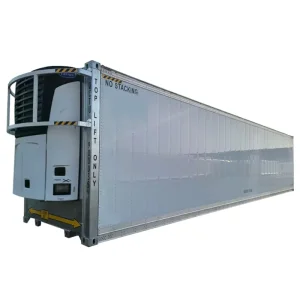
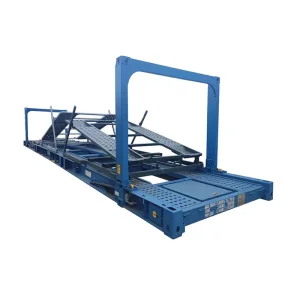
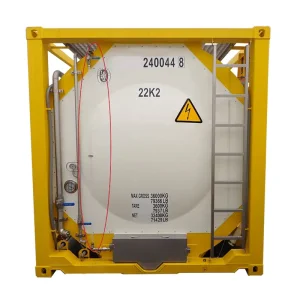
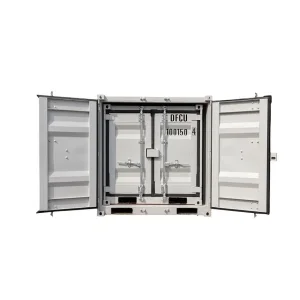
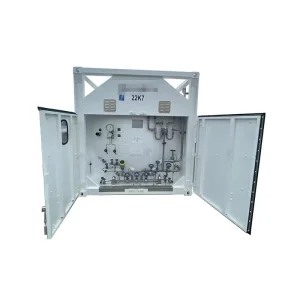
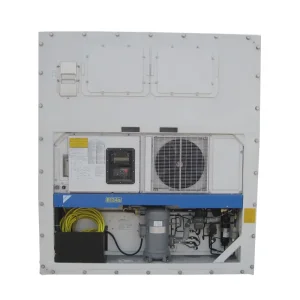
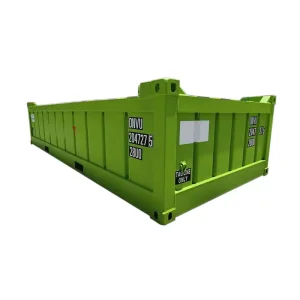
Explore heavy-duty intermodal platforms, cryogenic gas tanks, offshore-rated open tops, and high-efficiency Carrier/Thermo King powered climate units ready for dispatch or ODM tailor-engineering.
Analyzing structural kinematics, dimensional optimization over traditional ISO 668 profiles, and the logistical mathematics behind 2.500m and 2.550m intermodal platforms.
In modern supply chain architecture, spatial inefficiency within standardized maritime containers represents one of the largest systemic cost burdens across global intermodal operations. Standard ISO 668 containers possess an external envelope width of precisely 8 feet (2,438 mm), resulting in an internal usable aperture ranging from 2,330 mm to 2,352 mm depending on internal lining profiles. When handling European standard EUR-pallets (1,200 mm × 800 mm) or international industrial pallets (1,200 mm × 1,000 mm), this traditional envelope introduces a fundamental mathematical geometric conflict: two 1,200 mm pallet edges total 2,400 mm, physically prohibiting dual side-by-side orientation across the width. Consequently, transport operators are forced into inefficient pinwheel or single-file packing geometries, sacrificing up to 15% to 22% of floor deck capacity and requiring expansive pneumatic dunnage airbags to bridge internal voids.
ODM Container Wide (Pallet-Wide / PW) systems directly eliminate this structural bottleneck. Engineered with an exterior cross-section enlarged to 2,500 mm (standard Pallet-Wide) or 2,550 mm (maximum European road regulation width), these containers preserve standard ISO corner casting centers (2,259 mm aperture center-to-center) while outward-chamfering or offsetting the sidewall corrugations. This sophisticated metallurgical layout achieves internal widths of 2,440 mm to 2,470 mm. As a direct result, a 45ft Pallet-Wide High Cube container accommodates up to 33 Euro-pallets, contrasting decisively with the 27 Euro-pallets accommodated within a standard ISO 45ft box, or 30 Euro-pallets in a 40ft PW container versus merely 24 or 25 in an ISO equivalent.
The commercial imperative for custom-engineered wide containers extends far past continental palletized logistics. Global capital project contractors, specialized power-grid equipment integrators, and heavy-duty cold-chain operators increasingly require custom ODM wide enclosures ranging from 2,600 mm to 3,200 mm. These bespoke widths house high-capacity battery energy storage systems (BESS), multi-megawatt rotary data server architectures, and oversized mobile industrial equipment while maintaining CSC safety structural ratings for multimodal ship-to-rail-to-road handling.
How the integration of localized Corten supply clusters, high-amperage robotic multi-pass welding, and coastal port logistics deliver unmatched cost-to-payload performance.
Direct supply lines with tier-1 metallurgical foundries (Baosteel, Ansteel) guarantee uniform SPA-H Corten weathering steel with high atmospheric corrosion resistance and 345 MPa yield integrity across extreme marine climates.
Automated MIG/MAG 6-axis welding gantries enforce continuous, low-porosity longitudinal welds along side-wall corrugations, front bulkheads, and corner post gussets, surpassing ISO 1496 diagonal racking thresholds.
Automated shot-blasting to Swedish SA 2.5 standard followed by zinc-rich epoxy priming (30µm), high-build epoxy intermediate barriers (40µm), and polyurethane topcoats (40µm) achieving 1,500+ hour salt-spray endurance.
With massive primary fabrication compounds located in Tianjin and Suzhou approximately 100km from primary deep-water container terminals, empty haulage repositioning expenses and dispatch lead times are minimized.
Continuous on-line verification by Bureau Veritas (BV), Lloyd’s Register (LR), and Det Norske Veritas (DNV) certifies full CSC, TIR, UIC 592, and EN 12642 Code XL dynamic structural compliance.
Detailed design specifications contrasting standard ISO geometries with specialized Pallet-Wide (PW) and custom heavy-load wide platforms.
| Dimensional / Structural Parameter | Standard ISO 40ft High Cube | 40ft Pallet-Wide (PW) High Cube | 45ft Pallet-Wide (PW) Intermodal | Custom 20ft Wide Heavy-BESS |
|---|---|---|---|---|
| External Length | 12,192 mm (40' 0") | 12,192 mm (40' 0") | 13,716 mm (45' 0") | 6,058 mm (19' 10.5") |
| External Width | 2,438 mm (8' 0") | 2,500 mm (8' 2.4") | 2,500 mm / 2,550 mm | 2,800 mm to 3,000 mm (Bespoke) |
| External Height | 2,896 mm (9' 6") | 2,896 mm (9' 6") | 2,896 mm (9' 6") | 2,896 mm / 3,100 mm |
| Internal Clear Width | 2,352 mm (7' 8.6") | 2,440 mm (8' 0.1") | 2,444 mm to 2,470 mm | 2,700 mm to 2,900 mm |
| Max Gross Weight (Rating) | 32,500 kg (71,650 lbs) | 34,000 kg (74,950 lbs) | 34,000 kg (74,950 lbs) | 36,000 kg to 42,000 kg (Reinforced) |
| Tare Weight (Nominal) | 3,850 kg | 4,120 kg | 4,780 kg | 4,350 kg to 5,200 kg |
| Floor Structure Specification | 28mm Hardwood Marine Plywood | 28mm Plywood / 4.5mm Checker Steel | 28mm Plywood / Composite Omega Beam | 5.0mm–6.0mm Anti-Slip Steel Plate |
| Euro-Pallet Intake (1.2m × 0.8m) | 24 to 25 Pallets | 30 Pallets (+20%) | 33 Pallets (+22%) | Project Specific / Heavy Machinery |
| Corner Casting Spacing (Transverse) | 2,259 mm (ISO 1161 Standard) | 2,259 mm (Chamfered Corner Posts) | 2,259 mm (ISO Cell-Guide Ready) | Dual-Position Corner Apertures |
| Structural Compliance Standards | ISO 1496-1, CSC, UIC | ISO 1496-1, EN 12642 XL, CSC | EN 12642 Code XL, UIC 592, CSC | DNV 2.7-1 / EN 12079 / ISO 10855 |
The defining mechanical breakthrough in ODM Pallet-Wide manufacturing is the chamfered corner pillar assembly. Standard cellular containership cargo holds feature fixed vertical steel cell guides spaced to accommodate standard 2,438 mm exterior width containers. To ensure a 2,500 mm or 2,550 mm wide box can lower smoothly into these cellular ship holds without jamming, our engineering team manufactures cast-steel corner posts that taper inwards at the precise 40ft/45ft twistlock coordinates.
The top and bottom ISO 1161 corner castings align exactly with standard automated spreader cranes, twistlocks, and rail bolster pins. Meanwhile, the intermediate vertical side corrugations extend outward by 31 mm to 56 mm on each side, maximizing internal volumetric capacity without sacrificing intermodal handling compatibility.
How leading 3PL freight forwarders, retail giants, and industrial consortia deploy wide containers across Europe, the Americas, and trans-continental corridors.
By conforming seamlessly with European road limit regulations (Directive 96/53/EC allows 2.55m dry and 2.60m temperature-controlled bodies), 45ft PW containers operate as road-trailer replacements, transferring friction-free between rail spine cars and ro-ro vessels across North Sea and Mediterranean corridors.
Where 53ft domestic containers dominate rail, custom 40ft and 45ft wide units provide the exact ocean-to-rail interline bridging needed for heavy FMCG, beverage, and agricultural products exceeding highway axle weight limits before cube-out occurs.
Refrigerated Pallet-Wide variants engineered with high-density polyurethane vacuum-injected sandwich panels achieve heat-leakage coefficients as low as U = 0.36 W/m²K while preserving the crucial 2,420 mm internal clear width for twin Euro-pallet layouts.
Utility-scale battery energy storage systems (BESS) require external widths of 2,800 mm to 3,000 mm to fit high-voltage lithium battery racks along both walls while retaining a safe 900 mm central maintenance egress corridor meeting OSHA and NFPA 855 fire egress codes.
Consider a high-volume FMCG enterprise dispatching 1,000 container journeys annually on a shortsea-rail link between Rotterdam and Milan. Utilizing standard ISO 40ft High Cube containers (24 Euro-pallets capacity), moving 33,000 pallets requires 1,375 container journeys.
Transitioning to 45ft Pallet-Wide High Cube containers (33 Euro-pallets capacity) reduces the trip requirement to precisely 1,000 container journeys—eliminating 375 full freight legs. At an average multimodal corridor cost of €1,450 per journey, the annual gross freight savings total €543,750. The initial equipment procurement premium for bespoke Pallet-Wide engineering is completely amortized within the first 14 months of fleet deployment.
Key technological vectors reshaping high-payload container engineering over the coming decade.
To reduce tare weight while combating tropical timber deforestation regulations, advanced ODM manufacturing utilizes recycled continuous fiber reinforced thermoplastic (CFRT) sandwich floors. CFRT delivers 200 kg tare savings per 40ft container while resisting moisture absorption and chemical spills.
Factory-integrated solar-harvesting micro-telematics devices embedded flush within the corner post structural rebate monitor real-time GPS locations, door security status, tri-axial dynamic impact forces, and structural cargo vibration across intermodal journeys.
European road freight mandates stringent cargo-securing standards. Modern Pallet-Wide side walls and reinforced front-bulkhead crash panels are crash-tested and certified to EN 12642 Code XL standards, absorbing up to 40% of cargo payload sideways without external strapping or chains.
A structured technical protocol for supply chain directors, fleet engineers, and procurement teams submitting Requests for Quotation (RFQs).
Specify transit modes (cellular maritime vessels, inland waterways, rail pocket wagons, skeletal trailers) and confirm width limits (2,500 mm vs 2,550 mm vs 3,000 mm).
Factory engineering initiates 3D Finite Element Analysis (FEA) modeling to evaluate stress distribution across roof headers, gooseneck tunnels, and bottom side rails under maximum dynamic load.
Drawings and calculation sheets undergo formal engineering submission to BV, DNV, or LR to obtain Type Approval, CSC Prototype Testing certification, and customs TIR placards.
Initial factory build undergoes standard ISO 1496 verification: 86,400 kg stacking test per post, 7,260 kg forklift axle test, transverse racking, longitudinal end-wall, and weather tightness water testing.
Key technical insights on stacking capabilities, cell-guide clearance, road permissions, and custom engineering parameters.
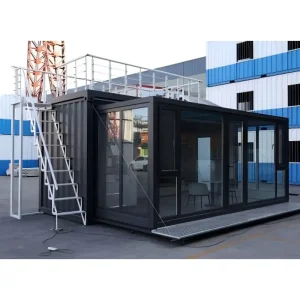
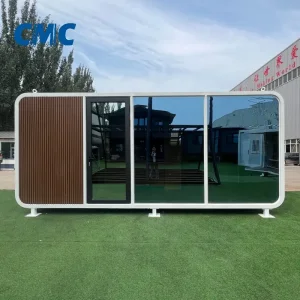
Explore heavy-duty dual-end door dry vans, cryogenic tank configurations, high-cube reefer equipment, and expandable modular living/office accommodations engineered to strict classification codes.