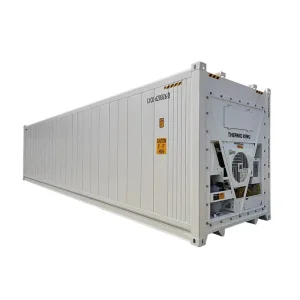
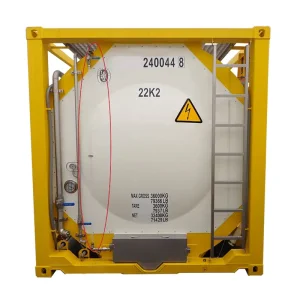
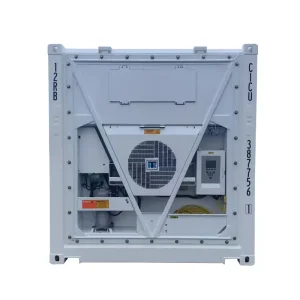
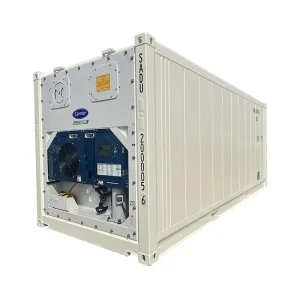
Verified heavy-duty intermodal enclosures, thermal containment units, and high-performance certified shipping hardware ready for immediate global logistics assignment.
How the structural evolution from standard ISO 8ft 6in to 9ft 6in 20 Ft High-Cube platforms is transforming volume optimization, dense machinery integration, and cross-continental routing.
Traditional 20-foot standard dry boxes provide approximately 33.2 cubic meters (1,172 cu. ft) of interior capacity. The shift toward 20 Ft High-Cube variants (9ft 6in height) expands total internal cube space to 37.4 cubic meters—an immediate 12.6% volumetric yield gain without altering the standardized ISO footprint.
This headroom expansion resolves longstanding logistics inefficiencies for low-density/high-cube freights, robotics housing, high-aspect battery cabinets, and modular fluid reservoirs.
Modern high-stress intermodal applications require specialized SPA-H atmospheric corrosion-resistant steel. These alloys feature minimum tensile yield points of 355 MPa, engineered to endure persistent dynamic shear loads during high-sea pitching and yawing.
The contemporary 20 Ft High framework serves increasingly as an industrial equipment chassis rather than a simple transit container. From hazardous chemical safety pods to mobile cryptocurrency units and high-voltage grid substations, structural adaptation requirements are surging worldwide.
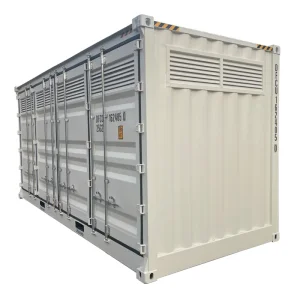
Integrated full-side opening assemblies, acoustic ventilation louvers, explosion-proof pressure relief valves, and reinforced underfloor cross-members accommodate concentrated static masses exceeding 30,000 kg.
Integrating automated laser contouring, intelligent multi-axis robotic welding cells, and seaport-adjacent manufacturing nodes to deliver uncompromising intermodal quality at scale.
Modern container fabrication eliminates dimensional deviations via closed-loop sensory vision robotics. Automated sub-assembly tracks weld the floor bearer grid, corrugated Corten side panels, and end-frame profiles with continuous gas metal arc welding (GMAW).
This automated flow guarantees full-penetration structural bonds, minimizes thermal distortion across large steel spans, and secures millimeter-level squareness for smooth stackability up to 9-high fully loaded stacks.
In accordance with international environmental standards, manufacturing operations have transitioned from solvent-borne formulations to automated waterborne zinc-rich primer and polyurethane topcoat lines.
Every modular chassis leaving the production bay carries a persistent digital footprint. Structural steel batch chemistry, ultrasonic weld inspection certificates, paint thickness readings, and pressure cycle records are cataloged in an enterprise MES network.
This rigorous transparency guarantees total conformance to ISO 1496-1, CSC (Convention for Safe Containers), Bureau Veritas (BV), and DNV standards for critical offshore deployment.
Comprehensive technical breakdown designed for EPC contractors, logistics directors, and hazardous materials procurement specialists evaluating structural investments.
| Dimensional & Functional Metric | 20 Ft Standard Dry (8ft 6in) | 20 Ft High-Cube (9ft 6in) | 20 Ft Dangerous Goods / Vent | 20 Ft Offshore DNV 2.7-1 |
|---|---|---|---|---|
| External Height (mm / ft) | 2,591 mm (8' 6") | 2,896 mm (9' 6") | 2,896 mm (9' 6") | 2,896 mm (Custom heights) |
| Internal Cubic Capacity | 33.2 m³ (1,172 cu.ft) | 37.4 m³ (1,320 cu.ft) | 35.8 m³ (Equipped) | 28.5 - 34.0 m³ (Reinforced) |
| Max Gross Weight (M.G.W.) | 30,480 kg (67,200 lbs) | 30,480 - 32,500 kg | 30,480 kg | 15,000 - 25,000 kg Dynamic |
| Tare Weight (Baseline) | 2,180 - 2,250 kg | 2,350 - 2,450 kg | 2,700 - 3,100 kg | 3,800 - 4,500 kg |
| Primary Floor Substrate | 28mm Marine Plywood / Bamboo | 28mm Hardwood / Steel Plate | Steel Checkered / Bunded Sump | Integrated Non-Slip Heavy Steel |
| Target Industrial Utility | General ocean freight & dry storage | Heavy volumetric goods & EV pods | Classified chemicals, paints, fuels | North Sea oilfields & mining rigs |
| Global Certification Standard | ISO 1496 / CSC | ISO 1496 / BV | EN 12079 / CSC | DNV 2.7-1 / EN 12079 |
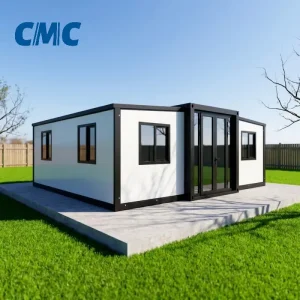
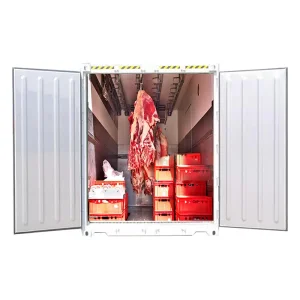
Examining field-tested performance across extreme offshore environments, automated cold-chains, and modern architectural modular pod integration.
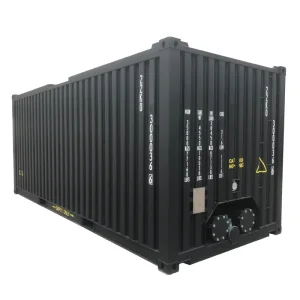
Equipped with low- and high-level spark-proof ventilation louvers, internal emergency escape locks, and integrated containment bunds designed to retain liquid chemical spills. Ideal for remote mining sites, processing plants, and port holding depots needing compliance with environmental protection protocols.
The extra 305mm (12 inches) vertical clearance in the 20 Ft High envelope enables seamless installation of overhead HVAC ducting, power cables, and FM-200 fire suppression equipment over high-density lithium-ion Battery Energy Storage Systems (BESS) and high-density AI compute nodes.
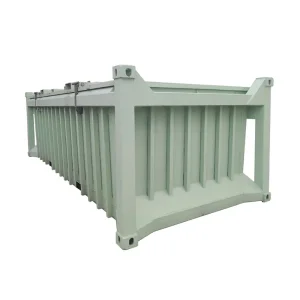
Offshore oil rigs and deep-sea support vessels depend on specialized half-height and full-height offshore carriers built to withstand -20°C brittle fracture dynamics. Heavy pad-eyes welded to main corner structures provide secure attachment points for four-legged wire rope slings during rough sea lifting.
In-depth responses from our structural engineering and export compliance teams to simplify your purchasing decisions.
A 20 Ft High-Cube (9ft 6in / 2,896 mm exterior height) yields 37.4 m³ of storage capacity compared to 33.2 m³ for a standard 8ft 6in enclosure. This extra foot of height provides room for standard industrial pallets to be double-stacked, accommodates high machinery without roof modification, and allows adequate overhead clearance for cabling and ventilation.
Our dangerous goods containers feature bunded drip trays with floor drainage taps to contain leaks, full-perimeter spark-resistant louvered vents, and high-spec security locking hardware. Every unit is manufactured under ISO 9001 and ISO 14001 frameworks and validated with comprehensive hydro-testing and weld examinations before shipping.
Yes. All 20 Ft High-Cube containers strictly follow ISO 668 dimensions for width (8ft / 2,438 mm) and length (20ft / 6,058 mm), and incorporate standard ISO 1161 corner castings. They seamlessly integrate with commercial ship twist-lock systems, rail flatcars, and semi-trailer skeletal chassis worldwide.
While standard dry and reefer products can be ordered in single units, custom ODM/OEM designs (such as full side-opening doors, custom louver cutouts, and reinforced equipment bases) are evaluated per engineering scope. We offer complete technical drawing sign-offs before starting small-batch pilot runs or full production schedules.
Engineered cold-storage systems, offshore transport configurations, and architectural modules meeting strict international safety standards.